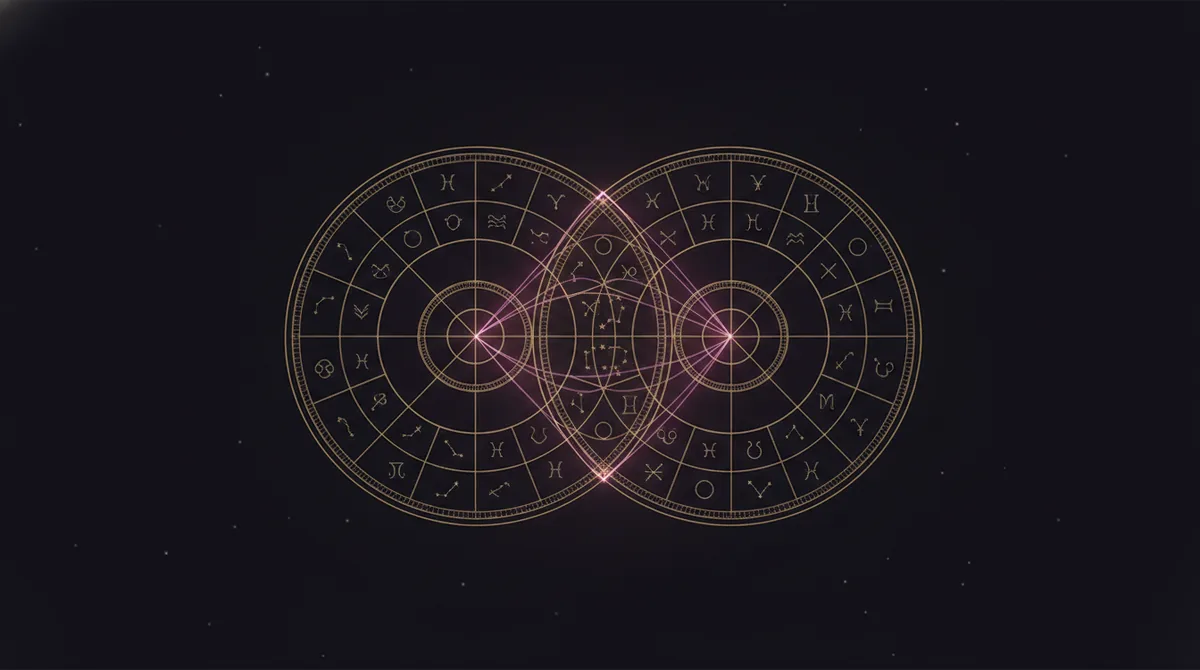
What kundli matching is
Kundli matching, also called gun milan or horoscope matching, compares the birth charts of two people to assess compatibility for marriage. The classical method is Ashtakoot Milan: eight factors, scored separately, adding up to 36 gunas.
It is not one judgement. It is eight different questions, each weighted differently, and the answer lives in the pattern rather than the total.
The eight kootas, and what each one asks
| Koota | Points | What it reads |
|---|---|---|
| Varna | 1 | Working temperament and approach to duty |
| Vashya | 2 | Natural pull and influence between the two |
| Tara | 3 | Health, fortune and wellbeing of the pairing |
| Yoni | 4 | Physical and instinctive compatibility |
| Graha Maitri | 5 | Mental friendship, how the two minds meet |
| Gana | 6 | Underlying nature and disposition |
| Bhakoot | 7 | The long arc: family, prosperity, direction together |
| Nadi | 8 | Health, vitality and progeny |
The weighting is the point. Nadi carries 8 points on its own and Varna carries 1. Any tool that treats the eight as equal is not doing Ashtakoot.
All eight are calculated from the Moon's position at birth: your Rashi (Moon sign) and your Nakshatra (lunar mansion). That is why birth time matters so much here. The Moon moves through a full Nakshatra in roughly a day, so an hour of error can shift several kootas at once. You can generate a free kundli to see where your own Moon sits.
Reading the score honestly
- Below 18 is traditionally considered a weak match
- 18 to 24 is workable
- 25 to 32 is good
- 33 to 36 is rare enough to be worth re-checking the birth data
Here is the part most summaries skip: the total hides the shape. A score of 28 assembled with a zero on Bhakoot is a genuinely different situation from 24 spread evenly across all eight. The first looks better on paper and reads worse in practice.
Astrologers look hardest at zeros on Bhakoot and Nadi, because those two carry 15 of the 36 points between them.
Why swapping the two people changes the answer
Several kootas are scored in one direction, from the groom to the bride. Tara and Vashya in particular are not symmetric.
This surprises people who expect compatibility to be a mutual quantity. In this system it is not. The two charts are not interchangeable, and a tool that returns the same score regardless of which person you enter first is not implementing the method correctly.
Doshas, and the cancellations nobody mentions
Nadi dosha occurs when both people share the same Nadi. It is the heaviest single deduction in the system. It also has well-documented cancellations, including when both share the same Rashi but different Nakshatras, or the same Nakshatra with different padas.
Bhakoot dosha arises from certain Moon sign distances between the two charts, and has its own exceptions depending on the relationship between the lords of the two signs.
Mangal dosha is checked separately from the 36 gunas entirely. It looks at Mars in specific houses from the ascendant, Moon or Venus. Its weight depends on which house and which sign, and it has recognised cancellations, including when both partners are Manglik.
The consistent theme: a dosha is a flag to investigate, not a verdict to act on. Detecting one is arithmetic. Knowing whether the cancellation applies to a specific pair of charts means reading both charts fully.
What gun milan does not tell you
This is worth saying plainly, because the score gets carried far beyond what it was designed for.
Ashtakoot reads the Moon: mind, emotion, instinct, temperament. It was built to assess one dimension of a marriage in a particular social context. It does not read career trajectory, financial compatibility, how two families will get along, or whether either person is ready for marriage. Those live in other parts of the chart, and mostly outside astrology altogether.
A high score is not a guarantee, and a low score is not a prohibition. Treat 36 gunas as one input among several.
How to get an accurate match
You need three things from both people:
- Date of birth
- Time of birth, as precisely as you can get it
- Place of birth, for the correct coordinates and timezone
Birth time is the one people guess at, and it is the one that changes the answer most. If you genuinely do not know it, use the closest time you have and treat the result as approximate rather than final.
Run it on your own charts
Aura AI runs the full Ashtakoot calculation on both charts, scores all eight kootas separately, checks Mangal dosha and Nadi, and explains the shape of the result rather than handing you a number and walking away.
- Start with free kundli matching for both charts
- Generate a free kundli if you do not have your chart yet
- Try a quick reading with the love calculator
- Or ask an AI astrologer what a specific zero or dosha means for your pair
Your first question is free.
Common questions
How many gunas are needed for marriage?
18 out of 36 is the traditional minimum. Below 18 is considered weak, and 25 and above is good. The distribution across the eight kootas matters more than the total, because the same score can be assembled very differently.
Is 36 out of 36 a good score?
It is extremely rare and usually worth double-checking the birth details before celebrating. Classical texts do not treat a perfect score as automatically ideal either, since some difference between two people is regarded as healthy.
Can marriage happen with Nadi dosha?
Nadi dosha has several recognised cancellations, and whether they apply depends on the full charts rather than the Nadi comparison alone. It is a reason to look closer, not a stopping point.
Does gun milan work for love marriages?
The calculation does not know how a couple met. It reads the same two charts either way. Many people use it as one perspective among several rather than as a decision.
What if we do not know the exact birth time?
Use the closest time you know. The Moon changes Nakshatra roughly once a day, so a large error can move several kootas at once. Treat a borderline score from an uncertain birth time as provisional.