The rule in one line
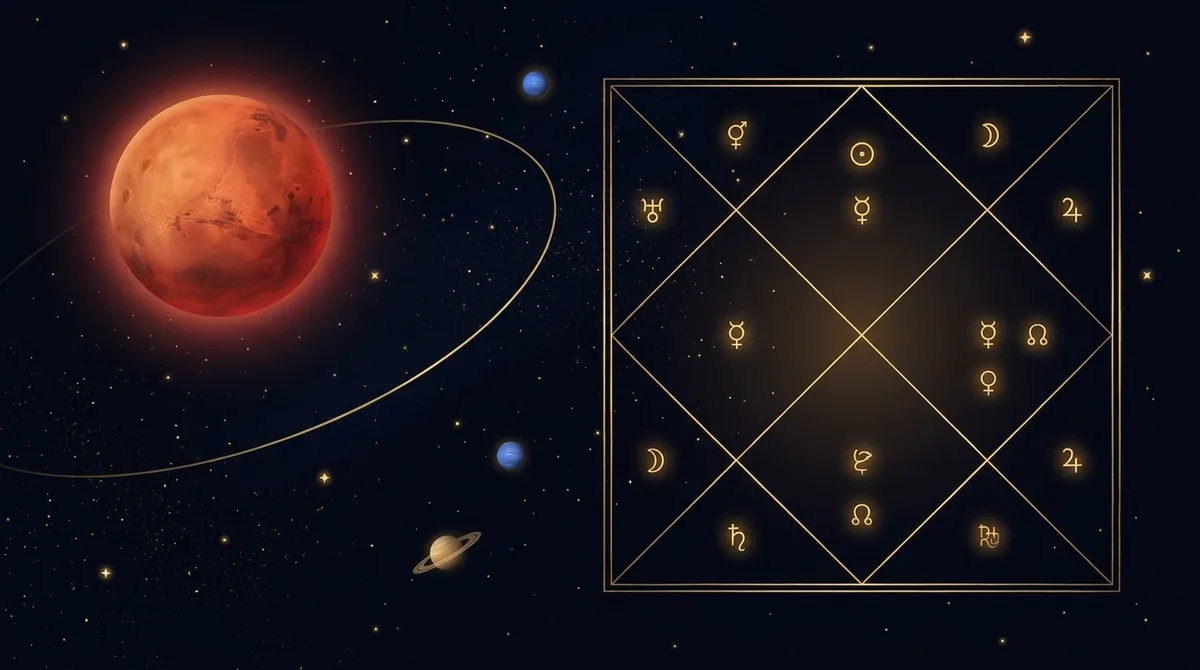
A chart is called manglik, the condition itself being mangal dosha or kuja dosha, when Mars occupies the 1st, 2nd, 4th, 7th, 8th or 12th house. Most astrologers count from the lagna and from the Moon, and the stricter South Indian tradition adds the count from Venus. That is the whole rule. Everything else is interpretation.
Notice what the rule implies: six houses out of twelve, counted from up to three reference points. Run the arithmetic and a very large share of all charts qualifies at least loosely. If the label alone doomed marriages, most marriages would be doomed. The texts themselves are more careful than the fear is, which is exactly why the details below matter.
Why these six houses
Mars in Jyotish is heat, drive and the willingness to fight. None of that is bad, it builds careers and defends families. The dosha only arises where that heat lands on the houses that hold a marriage together.
| Mars in | What it touches |
|---|---|
| 1st | Your own temperament, the heat you bring into the partnership |
| 2nd | Family life and speech, counted in the South Indian tradition |
| 4th | Home, domestic peace, comfort under one roof |
| 7th | The spouse and the marriage itself, the strongest placement |
| 8th | The marriage's longevity and shared fortunes, equally weighty |
| 12th | Bed comforts, private life and expenses |
The 7th and 8th carry the most weight, the spouse and the marriage's own longevity. Mars in the 1st, 2nd, 4th or 12th is read as milder friction: temper, family disputes, restlessness at home. An astrologer who treats all six placements as equally grave is reading the folklore, not the chart.
Anshik manglik: the partial dosha
Much of the panic dissolves right here. When Mars is doshic from only one reference point, say from the lagna but not from the Moon, or when it sits in one of the milder houses, the chart is anshik manglik, partially afflicted. Many charts waved off as manglik in conversation are anshik on inspection, and the classical remedy lists treat the two very differently.
The cancellations the texts actually give
Jyotish rarely states a dosha without stating its bhanga, the conditions that cancel or soften it. For mangal dosha the recognised ones are specific:
- Mars in its own signs, Aries or Scorpio, or exalted in Capricorn. A dignified Mars is considered disciplined heat, and several texts waive the dosha outright.
- Mars conjunct or aspected by Jupiter, the classic benefic restraint on a hot planet.
- Sign-specific exceptions by house, for example Mars in the 7th in Cancer or Capricorn, or in the 8th in Sagittarius or Pisces, listed in the muhurta literature.
- Both partners manglik. Strictly this is matching rather than cancellation, the two doshas are held to offset each other, and it is the single most used resolution in practice.
The pattern to notice: every cancellation requires looking at the whole chart, the sign, the aspects, the other person. The label manglik, by itself, tells you almost nothing actionable.
The age-28 belief, honestly
You will hear everywhere that manglik dosha ends after 28. The belief has a real root: in the naisargika maturity scheme Mars matures at 28, and a matured Mars is read as steadier, better at channelling its heat into work instead of quarrels. The person is also simply older.
What the texts do not say is that the dosha switches off on a birthday. If Mars sits in your 7th house it still sits there at 29. What changes outcomes is the running dasha, the strength of the rest of the chart, and who you marry. Treat 28 as a note about temperament, not an expiry date on a rule.
Manglik dosha in kundli matching
In traditional matching, mangal dosha is checked separately from the 36-guna score, which is why a pair can score well on gun milan and still be stopped over Mars. A complete match looks at three things together: the guna score, each chart's Mars placement from lagna, Moon and Venus, and whether any bhanga above applies. Only then does the dosha samya question arise, whether the two charts balance each other.
This is also where honest practice matters most. A marriage is not decided by one planet, and a reading that reduces a person to the manglik label is a bad reading. Check the claim, check the cancellation, then look at the whole chart.
Check your own chart
All of this is verifiable from your own birth details in a couple of minutes, calculated from an ephemeris rather than folklore.
- Run the free manglik calculator to see Mars's house from lagna and Moon, and whether a classical cancellation applies to you
- Generate your free kundli to see the full chart the answer comes from
- Matching two charts? Start with kundli matching for the 36-guna score alongside the Mars check
- Or ask the AI astrologer directly whether your Mars placement is doshic and what softens it in your specific chart
Your first question is free.
Common questions
What is manglik dosha?
Manglik dosha, also called mangal dosha or kuja dosha, is the condition of Mars sitting in the 1st, 2nd, 4th, 7th, 8th or 12th house of a birth chart, counted from the lagna and in many traditions from the Moon as well. Because those houses govern temperament, home, spouse and the marriage's longevity, classical texts treat a hot planet there as friction in married life, not as a verdict on it.
How do I know if I am manglik?
You need your birth date, exact time and place, nothing else. Cast the chart, find Mars, and check whether it occupies one of the six houses from the lagna and from the Moon. A free manglik calculator does this in seconds from an ephemeris, which beats guessing from a sun-sign table.
Can a manglik marry a non-manglik?
Yes, and such marriages happen every day. Tradition prefers matching two manglik charts because the doshas are considered to offset each other, but a strong overall match, a cancelled dosha or a mild placement changes the picture entirely. The sensible step is to look at both complete charts rather than stop at the label.
Does manglik dosha end after 28?
The belief comes from Mars's maturity age, which is 28 in the naisargika scheme. A matured Mars is considered easier to live with, and the person is older and steadier too. But no classical text says the dosha switches off on a birthday. What actually changes outcomes is the whole chart, the running dasha and who you marry.
Is manglik dosha scientifically proven?
No, and we will not pretend otherwise. It is a classical Jyotish rule, valuable as a lens for reflection on temperament and timing in marriage. Our view is the same here as everywhere on this site: astrology is guidance for self-understanding, not a medical or legal fact, and no single yoga should decide your life.